pyrolysis is better.
There are several thermal treatment methods that produce biochar. We’ve selected high-temperature pyrolysis as it provides the greatest potential for resource recovery, PFAS and VOC contaminant remediation, and the greatest potential for achieving ultra-low air and GHG emissions.
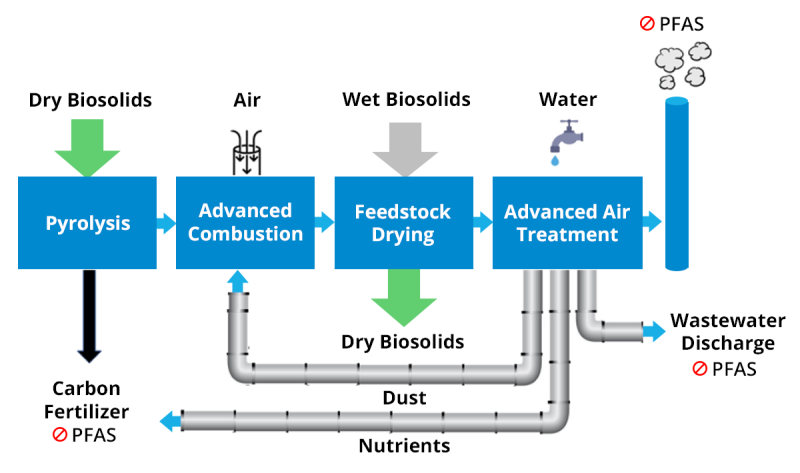
an integrated pyrolysis, advanced combustion, feedstock drying, and air treatment process.
cutting-edge pyrolysis technology.
High-temperature pyrolysis, carried out at precise time and temperature parameters, achieves a full separation of volatile organic compounds (VOCs), encompassing PFAS, microplastics, pharmaceuticals, hormones, and more, while effectively recovering a significant portion of energy compounds from biosolids. Through this process, contaminants and energy compounds are isolated from the solids, transforming into a state known as “pyro gas.” Subsequently, immediate thermal oxidation ensures the elimination of all VOCs, including stubborn PFAS compounds. Additionally, the thermal oxidation phase efficiently harnesses energy from the compounds and converts it into heat, which not only powers the biosolids drying process before pyrolysis but also offsets the necessity for natural gas or electrical energy for drying. Notably, this step also offers crucial high-temperature pre-treatment for air and greenhouse gas emissions.
Northeastern Biochar Solutions (NBS) remediates the pyro gas produced during pyrolysis using an advanced combustion methodology specifically designed to neutralize PFAS, recognized as one of the most challenging VOCs. This process ensures complete eradication of VOCs from both air emissions and wastewater, providing a definitive endpoint for these contaminants while simultaneously recovering energy for the overall process. Furthermore, NBS employs cutting-edge air treatment systems to minimize air emissions and eliminate odors, positioning them to qualify for a “minor source” air emissions permit.
managing odors and emissions.
The facility’s specialized building design effectively contains fugitive odors, ensuring a controlled environment for all activities. Indoors, an advanced air treatment system maintains negative pressure, further enhancing odor control and preventing any unwanted emissions. Within the confines of the facility, biosolids receiving, storage, handling, and processing are conducted, minimizing potential environmental impacts.
This comprehensive approach to emissions management sets new environmental benchmarks, reflecting the commitment to sustainable practices. Leveraging pyrolysis technology, the process guarantees the efficient separation of PFAS and other contaminants from biosolids, solidifying the facility’s dedication to environmental responsibility and effective waste treatment.
Advanced combustion system after pyrolysis ensures:
- PFAS and other contaminants are remediated from air emissions and facility wastewater.
- Nitrogen-based emissions meet strictest levels nationally (NYS CLCPA).
Advanced air treatment after drying ensures:
- Particulate, sulfur dioxide, ammonia, HAPs, and other air emissions meet strictest levels nationally (NYS CLCPA).
- Recycles nutrient-rich wastewater into Carbon Fertilizer.
- Achieves 99% odor reduction and high-dispersion.
safeguarding human health.
Our process yields ultra-low air emissions relative to incinerators which are being retired due to emissions.
- Carbon Fertilizer is composed of avoided emissions commonly emitted by incinerators which directly combust biosolids.
- The SBS facility is designed to process the equivalent of 15% of New York’s biosolids under a “minor source” State Air Facility permit.
- An incinerator of the same capacity would require a “major source” US EPA “Title V” air emissions permit.

benefiting climate change.
NBS’ process reduces net GHG emissions 137% relative to facility emissions on a lifecycle GHG basis that considers avoided GHG emissions from biosolids disposal methods, displaced GHG emissions from chemical fertilizer production, and carbon sequestration in soil where it is needed.
Note: Life-cycle analysis performed by EcoEngineers, 2022.

a carbon-negative footprint.
In this respect, being negative is very positive for climate change today.
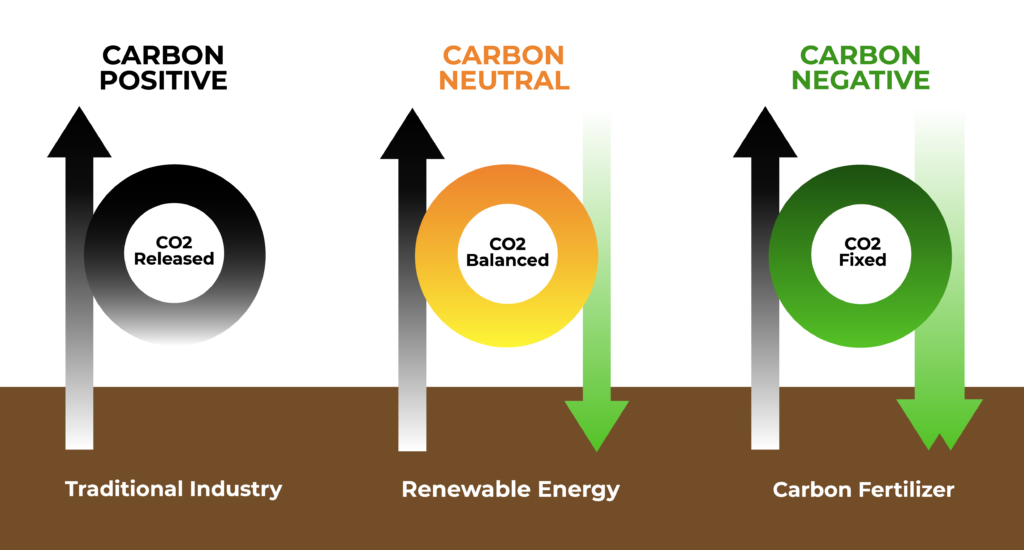
Northeastern Biochar Solutions’ process yields a “carbon negative” footprint which is a material improvement over wind, solar, and other renewable energy forms that are “carbon neutral.”
Carbon negative investments are highly desired to balance the abundance of “carbon positive” traditional industries already operating. In this respect, being negative is very positive for climate change today.